

From Cerro Pachón to the Frontiers of Astronomy
My astronomical pearls are the discoveries we don't even know are coming yet.
Danica Žilková
Even as a child, she showed all the signs of a true scientist. She loved exploring how things worked and writing her own projects. First, she dreamed of discovering the lost city of Atlantis; later, she wanted to design airplanes. Eventually, she chose to study physics. Her curiosity led her to the door of an astronomy department, where she was introduced to the study of space debris, a field she pursued from her bachelor's thesis through to her PhD research.
Today, she studies the Universe from hight of the Chilean Andes with one of the world's most advanced telescopes. As a member of a team conducting a ten-year survey of the sky, she helps gather data that may one day reveal the nature of dark matter and dark energy. Meet astronomer
Danica Žilková.
At the beginning of October, it marked one year since you joined the Vera C. Rubin Observatory in Chile. For many astronomers, this would undoubtedly be a dream job. In your case, however, that dream took shape only relatively recently. What did you want to be when you were a child?
I wanted to be an archaeologist. Ever since I was a little kid, I loved investigating things, exploring, and coming up with projects. My mother still laughs about it. She would be washing dishes in the evening while I stood in the kitchen presenting my latest projects to her. She had no choice but to listen as I explained all the mysteries I was trying to solve. One of them was a project called The Search for Atlantis. That was my big childhood obsession. I still have the binder where I kept all my notes and excerpts from books. Later, during high school, my focus gradually shifted towards science. At the time, I was fascinated by aviation, so I wanted to design airplanes.
Dolný Kubín and the Orava region are known for their dark skies. However, that alone does not make someone an astronomer. What was your first encounter with the night sky?
I attended the Milan Hodža Bilingual Grammar School (BGMH) in Sučany, and that’s where I was first introduced to astronomy by my physics teacher, Peter Pavlík. He was a charismatic and inspiring teacher who constantly encouraged us to work on different projects. He even ran a UFO club at the school. That was where I first became interested in the night sky. We worked on projects related to astronomy, including one about dark matter that earned us second place in the national Cascade competition.
I actually came to astronomy through physics. Physics appealed to me because it was logical and didn’t involve a lot of rote memorization. Astronomy came later, as I realized what a beautiful application of physics it is.
By the time you were in high school, information about space was already widely available. What most helped deepen your knowledge of astronomy?
I spent a lot of time at the library. I was a real bookworm, always checking out stacks of books. I would often sit there for hours reading and working on my projects. Of course, I also explored sources online.
That’s how I came across Carl Sagan’s documentary series Cosmos. I thought it was absolutely brilliant.
Do you remember your first astronomy book? Which one is your favorite?
I own a great many books, but I think my first astronomy book was Obloha na dlani (The Sky in Your Hand) by Dušan Kalmančok and Eduard Pittich. If I had to choose a favorite, it would be Contact by Carl Sagan.

Do you have a favorite astronomy quote?
I like a line from a poem. It may sound a bit sentimental, but it's beautiful:
“I have loved the stars too fondly to be fearful of the night.”
(Sarah Williams, The Old Astronomer, 1868)
You developed a strong foundation in English at your bilingual high school. It seems only natural that studying abroad would become an option after graduation. Where did you decide to go, and why?
Yes, my English skills helped me tremendously. Looking back, I would recommend it to every young person. English is absolutely essential nowadays. I'm very grateful to BGMH Sučany. The teachers were incredibly dedicated to us, and that opened doors to the wider world for me.
At school, we were encouraged to study abroad because all of our classes were taught in English. I applied to several universities in the United Kingdom, but in the end I chose to study Aerospace Engineering at Delft University of Technology in the Netherlands.
The reason was straightforward: the program was taught in English, and Delft is one of the world's leading institutions in this field. They are truly at the forefront of aerospace engineering. As I mentioned earlier, I was fascinated by aviation at the time. I loved everything about flying and wanted to design aircrafts.
Some people know from childhood exactly what they want to become, while others make up their minds at the last minute. What was it like for you?
I think I was fairly certain that I wanted to do some kind of science. I've been a researcher at heart since childhood. What I wasn't sure about was exactly what kind of science. I spent a long time deciding, even after high school. During my bachelor's studies in the Netherlands, I realized that engineering wasn't for me, although, paradoxically, I find myself working in that field again today. So I started looking for something else.
It was more or less by chance that, when I left the Netherlands, I applied to the Faculty of Mathematics, Physics and Informatics at Comenius University in Bratislava, and they accepted me immediately, without entrance exams.
Looking back, I'm very grateful for that, because I went on to study Physics at the bachelor's level, and that was where I found myself much more naturally. It simply made sense to me. At the time, the faculty was home to outstanding teachers such as RNDr. Vladimír Černý, who practically taught us how to think and instilled in us a love of physics.
Your time in Delft made the transition to studying at Comenius University much easier. How so?
That actually made things much easier for me, even though it was a bit of a detour. When I arrived at the Faculty of Mathematics, Physics and Informatics, I was able to transfer credits for several courses. As a result, gaps appeared in my study plan, and I boldly started enrolling in courses from higher years. I reorganized my studies in such a way that one semester ended up completely free, which allowed me to spend four months in Paris as an Erasmus exchange student. From the very first year of my bachelor's studies, I became deeply involved in astronomy. That, too, happened largely by chance. I found myself standing at the first door of the Department of Astronomy, knocked, and introduced myself to Professor Juraj Tóth. He showed me several projects where I could contribute, and that was how I first entered the world of astrophysics.
You chose to focus on space debris research. Why?
One of those projects was about space debris. At the time, my supervisor, Jiří Šilha, had just returned from a research stay in Switzerland and was beginning to develop this field of research in Slovakia as well. I found it incredibly interesting, mainly because it was a technical discipline that naturally connected to the aerospace engineering I had studied in Delft. It felt like a perfect intersection of my interests, and I was delighted to have found it.
What is this research actually about?
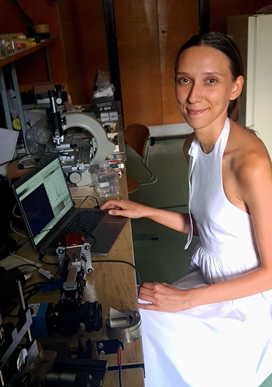
Space debris research focuses on tracking and characterizing human-made objects orbiting Earth that no longer serve any useful purpose. Many of them are fragments created by collisions in space. We monitor their positions, orbits, and physical properties such as composition, material degradation, rotation rates, and sizes. This work is important because Earth's orbital environment is becoming increasingly crowded as the number of space missions grows rapidly. In the future, we may face what is known as the Kessler Syndrome, a scenario in which collisions between objects in orbit trigger a chain reaction, making access to space increasingly difficult and potentially preventing humanity from venturing farther into space.
In the end, you devoted your bachelor's thesis, master's thesis, and doctoral dissertation to this topic. What fascinated you most about it?
It wasn't necessarily the topic itself that fascinated me the most, although there were certainly many unanswered questions I wanted to explore. What mattered most was that I had an excellent supervisor who built a wonderful research group at our faculty. While studying, we had opportunities to contribute to international projects, participate in research visits, workshops, and conferences, and interact with an outstanding scientific community.
That environment is incredibly important for young researchers. In many ways, it was the people and the opportunities around the project that kept me working on the topic for so many years.
You studied space debris at AGO Modra, where a 70 cm telescope is used for monitoring. Is it easy to distinguish space debris from near-Earth asteroids?
Yes, you can usually tell them apart from their orbits. We had a few cases where the identification wasn't immediately clear, and in those situations we used spectroscopy to determine the composition of the object's surface. In fact, that was exactly the area I specialized in.
When did your first opportunity to spend time abroad during university studies come along?
Because several of my courses from the Netherlands were also recognized at Comenius University, I was able to go on an Erasmus exchange, as I mentioned earlier. I spent it at the Paris Observatory, where I worked on a project that was completely unrelated to my research at the time. We were designing a stratospheric balloon mission to observe meteors. It was a fantastic experience, one I still remember fondly, particularly because I had an excellent supervisor and we got along extremely well. I also loved life in Paris. It's a beautiful city. I was fascinated by the interplay of light along its grand boulevards and by the architectural symmetry that I find so appealing. I had hoped to return there later for further studies, but COVID put an end to those plans. As a result, I completed both my master's and doctoral studies at the Department of Astronomy and Astrophysics in Bratislava, or rather, from my family home in Orava during the lockdowns. In the end, it worked out very well for me because, after a long time away, I was able to be close to my family again. I was truly happy about that.
During your doctoral studies, you traveled abroad again, this time to La Palma. How long did you stay there, and what was the purpose of the visit?
I visited La Palma twice during my PhD. The first stay was in 2023, when I spent one month there through the Erasmus program. I enjoyed it so much, and I was fortunate to have an excellent mentor there, Julia de León, that I decided to return the following year. The second stay lasted five months and was funded through a SAIA scholarship. Julia de León is a researcher at the Instituto de Astrofísica de Canarias (IAC) and an expert in asteroid spectroscopy, particularly in support of in-situ space missions. During my PhD, I worked on the spectroscopy of space debris, which is technically very similar to asteroid spectroscopy. The goal of my stay on La Palma was to deepen my expertise in these methods and adapt techniques developed for asteroid studies to the investigation of space debris. With Julia's support, we obtained spectra of satellites using the 10.4-metre Gran Telescopio Canarias (GTC). It was the first time the GTC had been used for this kind of measurement. We collected a remarkable dataset, which later became an important part of my doctoral dissertation.
In 2023, you also attended the Vatican Observatory Summer School. What were the main themes of the program?
That year's Summer School focused on large astronomical surveys and the application of machine learning in astronomy. It was there that I first learned about the Vera C. Rubin Observatory.
Interestingly, Vera Rubin herself had been among the early lecturers at the Vatican Observatory Summer School, which added an extra historical dimension to the experience.
Every international stay must have enriched you in some way. Which one proved most important for your future career?
Definitely La Palma. As I mentioned earlier, I worked there with the scientist Julia de León. I would say she became something like a scientific mother to me. She was truly fantastic. We got along extremely well. Sometimes fate has a way of bringing certain people into your life. You meet someone you connect with instantly, someone who feels like a soulmate.
Did you have a chance to visit any of the telescopes on La Palma?
Yes, several of them. I was fortunate to have wonderful colleagues who took me observing. I had the chance to observe with the Nordic Optical Telescope (NOT). One colleague jokingly said, "Come with me, I'll how you our 2.56-metre telescope." I also visited the Gran Telescopio Canarias (GTC), which I had already mentioned. Looking back, I was very lucky. Everywhere I went, I seemed to meet genuinely kind and supportive people.
You only began looking for your future workplace after completing your PhD. How did you first learn about the Vera C. Rubin Observatory?
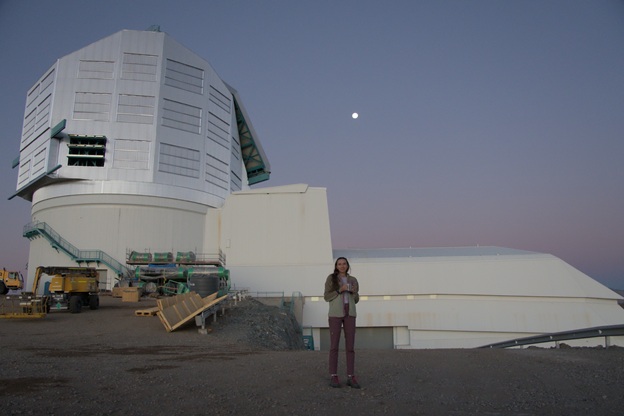
I first heard about Rubin at the Vatican Observatory Summer School. The then-Director of Rubin, Željko Ivezić, was one of our lecturers, and he told me about the observatory that was being built. Up until then, I knew nothing about it. I was completely focused on my own research. I simply took it as a piece of general information that, well, something was being built in Chile. As I was finishing my PhD, I started thinking about what kind of position would be best for someone just beginning a career in astronomy. I was planning to apply for a NASA postdoctoral fellowship and needed several letters of recommendation from my supervisors. I asked Željko for one, since he was based in the United States at the time, and during our conversation I casually asked whether he knew of any open positions and could forward them to me. As luck would have it, a position at Rubin opened up at exactly that time, so I applied for it.
Can you walk us through the selection process?
The recruitment process took about six months. It was quite unusual, actually. It was the only interview process I've ever been through where they sent me the questions in advance. I went through four rounds altogether. One of them was even a one-on-one interview. I spent an entire hour with a single person who questioned me the whole time. After that, they invited me to Chile. I was a little apprehensive about it at first, especially about traveling halfway around the world on my own. But they took very good care of me. They paid for my flights, sent me detailed instructions, gave me contact points and people to reach out to, and even arranged a dedicated driver for my transportation. In the end, I felt very safe. That was actually the final round, and afterwards they informed me that I had been selected for the position.
Do you remember the moment when you found out?
Yes, very clearly. I can still picture it exactly. I even cried a little. The wait felt long. It took three weeks before the email finally arrived. I knew there was another candidate in the running and that she had also been invited to Chile. I kept telling myself that if I wasn't selected, it wouldn't be the end of the world. But after seeing the observatory and experiencing the atmosphere there, I was completely captivated. They showed me what an incredible place it was. If they hadn't chosen me after that, I would have been genuinely disappointed.
Looking back, what do you think helped you get the job?
To be honest, probably my charisma, because we immediately got along really well. They were undoubtedly interviewing candidates with equally outstanding academic records, but what distinguished me was that we could talk openly and even share a laugh. Looking back, I understand that what mattered most to them was choosing someone who would fit naturally into the team.
Since October 2025, you have been working at the Vera C. Rubin Observatory as an Operations Specialist Astronomer. What were your first days after arriving like?
It was definitely challenging. The move to Chile as a whole was very demanding. Just a month before leaving, I was still defending my PhD dissertation, and my then-boyfriend and I had to get married so that he could obtain a visa and move with me. Rubin supported our relocation in every way. They paid for our flights, provided accommodation for the first month, and even lent us a car so that we could look for a place to live. I honestly can't imagine how we would have managed without that support. Finding housing was probably the hardest part. Then, of course, there was the challenge of adapting to life at the observatory, working night shifts at high altitude, and operating one of the most complex astronomical instruments in the world. It requires a great deal of physical training as well. I can safely say that during my first few months at Rubin, I learned more than I had in the previous ten years of my life. And I'm still learning.
Was there anything that surprised you, either positively or negatively?
What surprised me most in a positive way were definitely the people. They are incredibly kind, helpful, cheerful, and very friendly. I feel very good there, among those people. What surprised me in a negative way was the system in Latin America itself. There is a lot of discrimination and enormous inequality. Poor people often live in very poor conditions, while the wealthy live in extreme wealth. For me, as someone coming from Europe, that is simply very difficult to understand.
The Vera C. Rubin Observatory was not built simply to take beautiful pictures of the sky. How would you briefly summarize its scientific goals?
Our ten-year sky survey, the Legacy Survey of Space and Time (LSST), is built around four main science goals. The first focuses on our Solar System, including planets and asteroids. For example, if the hypothesized ninth planet is visible from the Southern Hemisphere, we will certainly discover it. The second focuses on our own galaxy, the Milky Way, and the stars within it. We plan to map more than 20 billion of them. Another major objective is cosmology: studying galaxies and supernovae, and investigating why we observe the accelerated expansion of the Universe. The fourth, and perhaps most important, goal is to better understand dark matter and dark energy, to observe gravity in action, and to study the formation of structure throughout the Universe. To achieve the required level of precision, we need to measure billions of galaxies, something that simply cannot be done with an ordinary telescope. Or rather, it can, but it would take thousands of years. We will do it in ten.
What exactly does an Operations Specialist Astronomer do? What are your main responsibilities?
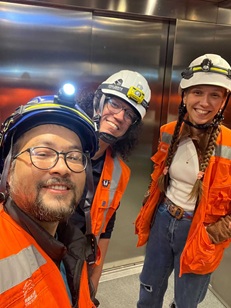
We are responsible for keeping the observatory running. During the day, we perform a series of tests on all the individual observatory systems: turning them off and on, checking that everything moves as it should, and taking test images. In this way, we monitor all the systems, from the hexapods and the dome to the LSST Camera itself. During the day, there are many engineers at the observatory, each following a scheduled work plan and carrying out their assigned tasks. In the evening, the observatory is handed over to the night shift.
Every four nights, we scan the entire observable sky, after which the imaging cycle begins again. We take 30-second exposures and reach a limiting magnitude of about 25. It varies slightly from one filter to another, but we go as deep as magnitude 25.
In most cases, we set one filter, take a series of images, move on to another area of the sky, change the filter, and then return to the original field. The observing sequence is determined automatically by the Scheduler, a sophisticated planning system developed by an entire team of scientists.
Your working "week" lasts four days and alternates between day and night shifts. Each shift is twelve hours long. How does the schedule actually work?
Our lives are organized into three-month periods. During each period, I spend four consecutive days on observatory duty, either on the day shift or on the night shift. Those four days are followed by four days off. After that, I spend another four days doing administrative work in the office. Then I return to the observatory. If my previous observing run was on the day shift, the next one will be on the night shift, and vice versa. So you can think of it as a repeating twelve-day cycle, after which the schedule starts over again.
What does a night shift look like?
A night shift consists of two astronomers. They exchange information with the day shift, one hour is allocated for this handover. The day shift must tell the night shift everything that happened during that day and what the night plan is so that the night shift knows what to expect. After that, the night shift begins observing. During observations, our primary responsibility is monitoring the weather. This is extremely important because clouds can arrive unexpectedly and it may start raining. We cannot allow rain to enter the dome. We also monitor the health of the system, making sure that everything is functioning as intended. The third area we are responsible for is image quality assurance, ensuring that the images we acquire meet the quality standards we require.
A shift begins just as the day ends. At sunset, we arrive at the observatory, meet with the day shift, and discuss what has happened during the day. They pack up and head back to the hotel to sleep, while we take over operation of the telescope. Although I trust the day shift to have done everything correctly, I always double-check everything myself: whether the telescope tracking speed is set correctly, whether the mirror is ready, and so on. The telescope has usually already been unparked by the day shift. We open the dome and begin focusing. We have a preferred location for focusing and always use the same area of the sky. We point both the dome and the telescope northward, usually at an altitude of about 70 degrees above the horizon, because we do not want to observe close to the horizon. We select a filter, usually i or r, and start focusing. The process usually takes about ten minutes while we monitor image quality.
In the images, the stars appear as little "donuts," and we watch how they come into focus. Those donuts can reveal things like astigmatism or thermal gradients. If it's very warm outside but cold inside the dome, we have to open it up and ventilate it. Sometimes that's not entirely possible, and for the first few hours we still have significant thermal noise. Once the telescope is properly focused, we start the scheduler and the telescope operates on its own. In the morning, we simply stop the scheduler and close the dome.
You collect 20 TB of data in a single night. That is an enormous amount of information. How should we visualize that number?
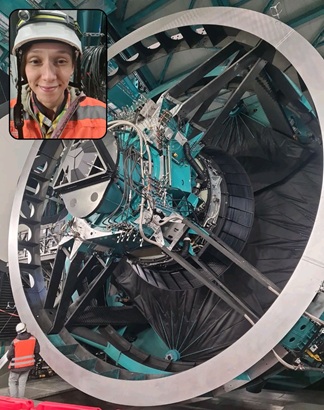
A single image from our telescope contains 3.2 billion pixels and is equivalent in size to 189 conventional images. While many observatories use a camera with a single detector, our camera contains 189 CCD sensors. The telescope's field of view is 9.6 square degrees, which can be imagined as an area roughly equivalent to 40 full Moons on the sky.
How does the actual processing workflow work?
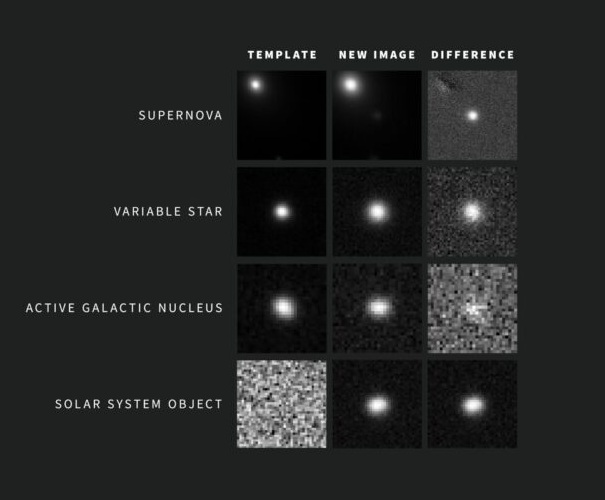
A single exposure lasts 30 seconds. The telescope then moves to the next field in about 5 seconds, and imaging continues. Within one minute, the captured image is transferred to our data center in La Serena, and another minute later it is already available to our colleagues in California. There, it is processed immediately and compared with all images acquired up to that point. This allows us to detect any changes right away, such as the motion of asteroids and comets or the explosion of a supernova. For every detected change, a notification known as an alert is generated. Alerts are distributed immediately world-wide through a dedicated processing pipeline, while every new discovery is still reported manually to the Minor Planet Center (MPC). This process is currently being optimized, as we expect enormous volumes of discoveries. We also receive the alerts and keep track of them. Our current record is over 2 million alerts in a single night!
If you come across something new, can you interrupt the observing schedule and follow up on the discovery?
No, we do not do that because the observing schedule is strictly defined. However, if we know several days in advance that something particularly interesting is going to happen, a so-called Target of Opportunity (ToO), we can adjust the observing plan accordingly.
Will your data also be available to amateur astronomers?
Of course. We have now released our second data preview, Data Preview 2, and it is completely public. In fact, all of our data will eventually be made public. One of the reasons for releasing these previews is to help us improve the accessibility of the data and make it easier for the public to use and understand. We want the data to be as user-friendly and understandable as possible. In addition, Rubin provides a wide range of tutorials and guides that are released alongside the data itself, helping people learn how to work with and analyze the datasets.
Only a handful of dedicated enthusiasts regularly explore the archives of professional observatories. How would you motivate young people to start working with archival data? It seems that genuine treasures are sometimes hidden within them.
I would probably tell them that technological progress and artificial intelligence are going to transform the job market. Until recently, many people assumed that software developers would never have trouble finding work, yet in just a few years a large part of programming will be carried out by AI. That is why I believe that scientific data analysis is one of the areas where we can make the best use of artificial intelligence. Working with astronomical observations is certainly worth pursuing. Astronomy is going to bring us remarkable discoveries. Of course, astronomy is not the only field where AI can be useful. Biology is another great example. Recently, researchers used artificial intelligence to help decode how ravens communicate with one another. I find that fascinating. We are beginning to understand the world around us at a level that would have been unimaginable not long ago. We are learning to understand birds! I think that is a very exciting direction to be heading in.
In one interview you said, "The most exciting thing for me would be searching for asteroids." That dream has come true...
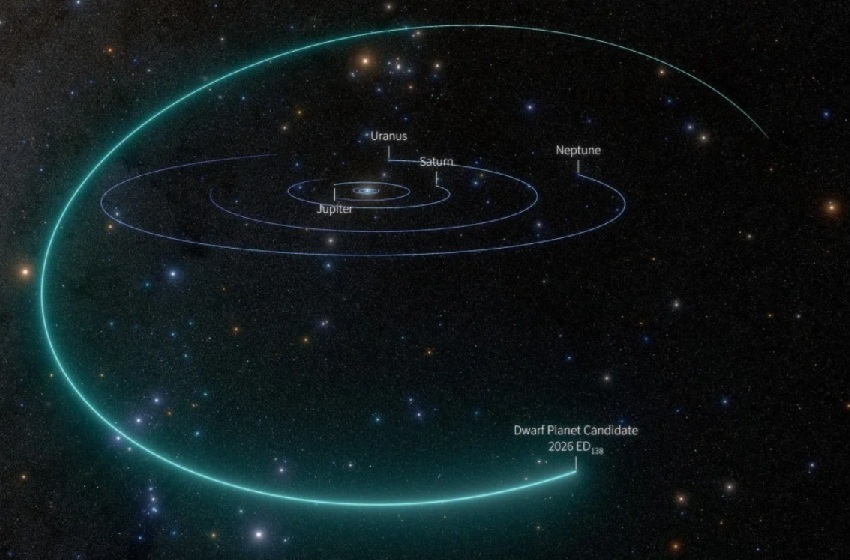
Yes. Discovering asteroids is one of Rubin’s key objectives. Thanks to the data collected over its ten-year survey, the number known asteroids is expected to increase fivefold. We currently know about one million asteroids, and soon that number could grow to five million. Asteroids are also important in addressing the question of how life arrived on Earth. Some theories suggest that life may have originated from material carried by an asteroid that struck our planet. We have discovered that certain asteroids in our Solar System contain water. We still do not know exactly when or how water molecules formed on Earth, and one hypothesis is that they were delivered here by asteroids. It is a fascinating topic.
Czech amateur astronomers use the expression “The Seven Pearls of Astronomy.” They consider “pearls” to be exceptional astronomical events they have witnessed, or would like to witness one day. What would your pearls be?
In the Southern Hemisphere, I came to appreciate just how magnificent the Milky Way is. It's something that those of us in the Northern Hemisphere can hardly imagine. At first, it's a bit disorienting because the constellations appear upside down. It took me a long time to get used to the fact that everything seems reversed, but our galaxy completely captivated me. What surprised me most was that when we visited Peru, I found the night sky there even more beautiful than in Chile, thanks to its higher altitude. We visited Lake Titicaca, which lies at around 4,000 meters above sea level. The night sky there was breathtaking. It was simply incredible. The stars looked like brilliant diamonds, sparkling across the sky.
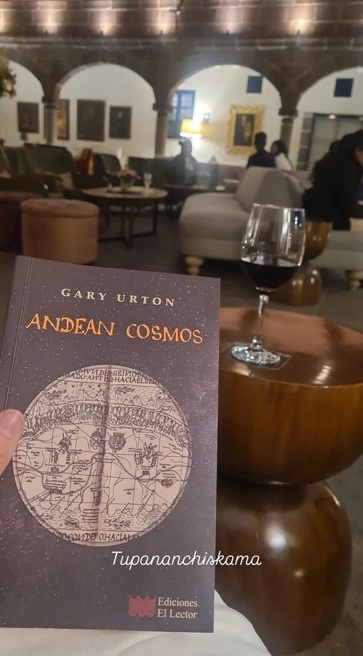
Our understanding of the universe constantly surprises me. One particularly memorable experience happened in Peru, where I unexpectedly found a new friend in a bookstore. I was looking for books about the astronomy of the ancient Incas. We started talking, and when I mentioned that I was an astrophysicist, he became incredibly enthusiastic. I ended up buying two books, and we have remained friends ever since. He is a Quechuan, and nowadays he teaches me words from the Quechua language. Through him, I learned that the Incas did not study the stars themselves. Instead, they focused on the dark regions within the Milky Way. They used these patterns to determine the autumn and spring equinoxes, when to sow their crops, when llamas would mate, and when the dry season would arrive. Now I observe these dark constellations myself from Chile. This experience made me realize how limited our perspective can be and how looking into the past can reveal entirely new ways of understanding the world. That is why my astronomical “pearls” are the discoveries we don't even know are coming yet. We call them unknown unknowns. We simply need to keep an open mind and be willing to look at things from a different perspective. Then, suddenly, unimaginable discoveries can emerge. Every revolutionary astronomical project has brought something like this, and I am excited to see what we will discover with Rubin.
Let’s go back to your work schedule for a moment. After completing your work rotation, you get a four-day weekend. How do you like to spend those days off?
I try to get back into a normal routine: sleeping at normal hours, eating proper meals, cooking for myself, and exercising. I try to stay active because during those twelve-hour shifts we're sitting most of the time, and that really bothers me. I simply miss being physically active.
You make up for the lack of movement by running, sometimes even marathons. How did you get into that?
I started running when I was on La Palma, probably around the age of 27. They have a famous race there called Transvulcania, which runs across the entire island. The second time I went there, I thought to myself, “I'm going to do it. I have to give it a try.” And that's really how it all started. It was a wonderful experience because there were six of us astronomers training for it together. We trained together, and encouraged each other.
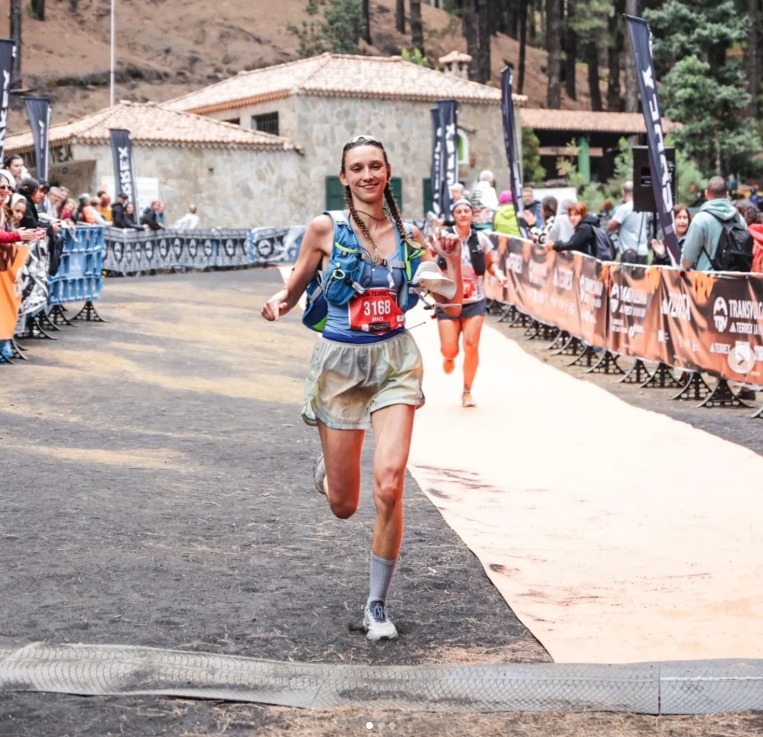
It was the Patagonia Marathon in early September. My husband and I ran it together as a way of celebrating our first wedding anniversary.
You know the world's most advanced observatory inside out. Are there any other observatories still on your wish list?
I would definitely like to visit the Extremely Large Telescope (ELT) at Paranal. It's a new 40-metre telescope that is currently under construction there. Colleagues who have visited the site told me that it is truly breathtaking. But for me, Rubin is my professional peak. I can't imagine finding a better place to work.
Is the Rubin observatory open to visitors?
Yes, it is, but public visits need to be booked in advance. Recently, the demand has been enormous. Everyone in La Serena wants to visit, so tours have been fully booked months ahead. We also have a Friends and Family Visitor Program. As employees, we can bring guests for a guided tour on weekends, usually on Saturdays. That's how I was able to show the observatory to my parents.
You work in the high-altitude Atacama region, where rainfall is extremely rare, and then suddenly a snowstorm hits. On July 15, a powerful windstorm swept through the area around the observatory, forcing you to evacuate. What exactly happened?
Statistically, it rains here about once a year, and when it does, it's usually just a single day of heavy rain that washes everything out. But that's normally not a major problem. This year, however, we've had a very strong El Niño event, a so-called Super El Niño. The Pacific Ocean has been unusually warm, and we can feel it ourselves. The weather overall has been very unusual. It should be winter, but instead it's been warm. That led to extremely heavy rainfall. The rain lasted for about a week. For people in Slovakia, it might have seemed like an ordinary autumn rainstorm, but here in Chile the desert soil simply can't absorb that much water, so it all runs off across the surface. Meanwhile, when it's raining near the coast, it's snowing in the mountains. The snow then melts, flows downhill, and feeds the rivers. Eventually, one enormous river formed and surged all the way to the ocean. It was a major natural disaster. Some people lost their entire homes. We even found refrigerators and televisions washed out into the ocean. It was terrible. The observatory wasn't spared either. The storm damaged infrastructure, destroyed bridges and roads, and even wiped out a water reservoir. Many people were without drinking water for twelve days, and there were power outages as well. It's hard to imagine until you've experienced it yourself, but suddenly we found ourselves without electricity and without drinking water. Everyday life simply came to a halt. It was awful.
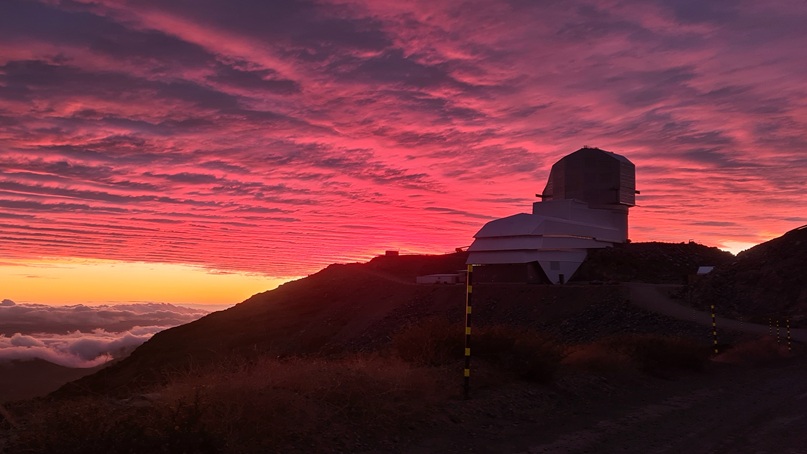
In the meantime, the infrastructure has been restored, but we're still not observing. We're currently in a shutdown period. It was originally scheduled for August, but it ended up being postponed three times. The shutdown is essential because we need to address a number of engineering issues and technical faults. To do that, the telescope has to remain offline for several consecutive days, which isn't possible during normal observing operations. The work involves around a hundred technicians. They have to stay on site and be accommodated and fed, so restoring the infrastructure had to come first. That was finally completed at the end of August. The shutdown was then moved to September, and now that everything is back in place, the engineering work is underway. Regular operations had only just begun at the end of June and lasted for about three weeks before they were interrupted by the storm.
Have you experienced any other dangerous or unsettling situations?
The worst were probably the earthquakes. Over the past year, there have been two earthquakes with magnitudes above 6. I only experienced one of them. Fortunately, we happened to be on vacation in another part of Chile during the second one, so we didn't feel it. I've heard it was quite unpleasant.
Can you ever get used to something like that?
I'd say Chileans are used to it, but I don't think I'll ever be. I find it very unsettling. Whenever I feel the ground start to shake, my instinct is simply to get out of the building as quickly as possible.
Would you be willing to work in even harsher conditions than those on Cerro Pachón, for example in the remote environment of Antarctica's South Pole?
I don't think I'd be brave enough for that, but I have Chilean colleagues who work in Antarctica, and they've told me some truly incredible stories about their experiences there. They've come across huge two-meter-long seals that can be surprisingly aggressive, so they have to watch out for them. And from what I hear, it's not even the cold that's the worst part, it's the wind. The wind is absolutely brutal.
And what about an even more extreme environment? Could you imagine being an astronomer at the Moon's south pole?
Wow. Not a chance. I don't even like roller coasters, let alone the idea of traveling into space. That's definitely not for me.
Where do you see yourself professionally ten years from now?
Definitely not at Rubin. I don't think this kind of schedule is sustainable for ten years. The only exception would be if circumstances somehow prevented us from returning to Slovakia. My husband and I would really like to come back home. That said, if for some reason we couldn't return, I would definitely stay with Rubin. If we're in Chile, Rubin is where I'd want to be. But in the long run, I see myself in Slovakia. I'd love to continue working with Rubin data from there. In fact, we're currently working on a process to bring Slovakia into Rubin's In-Kind Program, which involves partner countries collaborating with the observatory. I'd be thrilled if that comes together. It would allow me to return to Slovakia while still remain working with Rubin data remotely.
I'd also like to make room for other wonderful things in life. My husband and I would like to start a family, and I'd love for science to become just one part of my life rather than the center of it. I'd like to see it balanced with other priorities and experiences as well.
Are you suggesting that one day, alongside everything else, you might shift your attention from the sky to the ground beneath our feet and start uncovering the secrets of our ancestors, finally returning to your childhood dream?
I'm not ruling it out. My parents always told me, "First go into science, earn plenty of money, and then you can afford to do archaeology." They said archaeologists are all poor. And I completely fell for it. Then I eventually realized that scientists aren't exactly rich either.
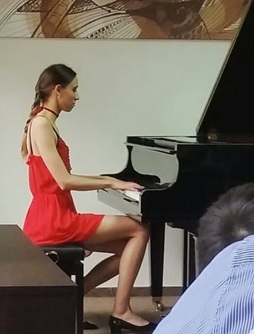
One final question: what would be more relaxing for you: playing Beethoven's Moonlight Sonata on the piano or running a marathon?
That's a good question. Definitely the piano. Sport is good for the body, but music feeds the soul.